
Sliding door systems

Sliding window systems SF40 / SF60 / SF80 – Sliding windows for patio access, conservatory and balcony

Are you planning a spacious patio entrance, a light-filled conservatory, or a modern, glazed balcony? Standard sliding windows quickly reach their limits in terms of appearance, insulation, weatherproofing, and security. The SUNFLEX sliding window systems SF40, SF60, and SF80, on the other hand, offer the ideal solution: elegant designs, smooth operation, three insulation levels, reliable RC2 burglar protection, maximum air and driving rain tightness, and above-average wind resistance. This way, you'll find the perfect sliding window for every project – from an airy summer garden to a year-round living space extension.


What are SUNFLEX sliding window systems SF40 / SF60 / SF80?

The SF40, SF60, and SF80 sliding window systems are horizontally guided aluminum sliding windows with an extremely high glass area (up to 98%), RC2 burglar resistance, and extra-narrow profile widths of 21 or 30 mm. The systems achieve exceptionally smooth operation thanks to ball-bearing stainless steel rollers and tracks. The sliding windows consist of 2- or 3-track frame profiles with 2 to 6 sliding panels and can be combined with corner elements. Typical applications include patio entrances, loggias, conservatories, and sunrooms. Depending on the application, you can choose between an uninsulated (SF40), thermally insulated (SF60), and highly thermally insulated (SF80) system.

SUNFLEX Configurator

Take your pick from the numerous opportunities SUNFLEX products have to offer you. Whether it's a folding / sliding system, a sliding door system, a sliding / turning system or a horizontal sliding wall - you can use the SUNFLEX Configurer to arrange your individual product just the way you want it. We would also be happy to help you with your configuration over the telephone - just give us a call.

Configure now

Which sliding window system is suitable for which project?

  • SF40 – uninsulated
    • Patio covers, pool houses, and seasonal areas
    • Unheated or only occasionally used rooms
    • Room dividers without high thermal insulation requirements

  • SF60 – thermally insulated
    • Patio doors and sliding windows in heated living spaces
    • Frequently used as sliding doors between indoor and outdoor areas
    • Conservatories with high, but not maximum, insulation requirements

  • SF80 – highly thermally insulated
    • Year-round living space extensions with high energy efficiency standards
    • Winterized conservatories and large-scale facade elements
    • Projects aiming for U-values ​​starting at 0.75 W/m²K (depending on size and glazing).

Specific system selection, glass construction and details are determined in the configurator and in consultation with your SUNFLEX specialist partner.

TO CONFIGURATOR

Product comparison

SF40

non-insulated aluminum system

SF40

non-insulated aluminum system
13,800 mm
1,000 mm
4,000 mm
500 mm
Min.2; max.6
no / not insulated
2-3 track
up to 12 mm
Yes
up to 22 mm
Follower function when the sliding panel is closed
Wind-tightness thanks to three sealing levels in the labyrinth area

SF60

Thermally insulated aluminum system

SF60

Thermally insulated aluminum system
13,800 mm
1,000 mm
4,000 mm
500 mm
Min.2; max.6
yes / thermally insulated
2-3 track
7 mm
Yes
32 mm to 34 mm
Follower function when the sliding panel is closed
Wind-tightness thanks to three sealing levels in the labyrinth area

SF80

Highly thermally insulated aluminum system

SF80

Highly thermally insulated aluminum system
13,800 mm
1,000 mm
4,000 mm
500 mm
Min.2; max.6
yes / highly thermally insulated
2-3 track
7 mm
Yes
52 mm to 54 mm
Follower function when the sliding panel is closed
Wind-tightness thanks to three sealing levels in the labyrinth area

Product features & technical data

Type of product
Max. system width
Min. system width
Max. system height
Min. system height
No. of panels
Thermal insulation
Floor tracks
Compensation of building tolerances
Barrier freedom
Glass thicknesses
Following function
Sealing/ventilation

SF40

non-insulated aluminum system

SF40

non-insulated aluminum system
13,800 mm
1,000 mm
4,000 mm
500 mm
Min.2; max.6
no / not insulated
2-3 track
up to 12 mm
Yes
up to 22 mm
Follower function when the sliding panel is closed
Wind-tightness thanks to three sealing levels in the labyrinth area

SF60

Thermally insulated aluminum system

SF60

Thermally insulated aluminum system
13,800 mm
1,000 mm
4,000 mm
500 mm
Min.2; max.6
yes / thermally insulated
2-3 track
7 mm
Yes
32 mm to 34 mm
Follower function when the sliding panel is closed
Wind-tightness thanks to three sealing levels in the labyrinth area

SF80

Highly thermally insulated aluminum system

SF80

Highly thermally insulated aluminum system
13,800 mm
1,000 mm
4,000 mm
500 mm
Min.2; max.6
yes / highly thermally insulated
2-3 track
7 mm
Yes
52 mm to 54 mm
Follower function when the sliding panel is closed
Wind-tightness thanks to three sealing levels in the labyrinth area

SF40

non-insulated aluminum system

SF40

non-insulated aluminum system
13,800 mm
1,000 mm
4,000 mm
500 mm
Min.2; max.6
no / not insulated
2-3 track
up to 12 mm
Yes
up to 22 mm
Follower function when the sliding panel is closed
Wind-tightness thanks to three sealing levels in the labyrinth area

SF60

Thermally insulated aluminum system

SF60

Thermally insulated aluminum system
13,800 mm
1,000 mm
4,000 mm
500 mm
Min.2; max.6
yes / thermally insulated
2-3 track
7 mm
Yes
32 mm to 34 mm
Follower function when the sliding panel is closed
Wind-tightness thanks to three sealing levels in the labyrinth area

SF80

Highly thermally insulated aluminum system

SF80

Highly thermally insulated aluminum system
13,800 mm
1,000 mm
4,000 mm
500 mm
Min.2; max.6
yes / highly thermally insulated
2-3 track
7 mm
Yes
52 mm to 54 mm
Follower function when the sliding panel is closed
Wind-tightness thanks to three sealing levels in the labyrinth area

At a glance

Technical features of each SUNFLEX sliding window system

  • Extremely high glass area up to 98% (panoramic windows)
  • Reliable burglar resistance up to RC2
  • Extra narrow profile views: 21 mm or 30 mm
  • Maximum width 13,800 mm, minimum 1,000 mm. Maximum height 4,000 mm, minimum 500 mm
  • 2 to 6 panels, 2-track or 3-track
  • Opening direction: left and/or right
  • Maximum panel weight: SF40 up to 400 kg, SF60/SF80 up to 800 kg
  • Flush-mounted threshold (barrier-free according to DIN 18024)
  • Ball-bearing stainless steel rollers and stainless steel tracks
  • Integrated closing mechanism
  • Three sealing levels in the labyrinth seal, meeting the highest airtightness requirements
  • Steel reinforcement at the center joint is possible for high wind loads
  • Combinable sliding, fixed, and corner elements (e.g., 90° corners)
  • Lowest U-values ​​from 0.75 W/m²K depending on size and glazing (SF60/SF80)
  • Glazing options: tempered safety glass (ESG), laminated safety glass (VSG), special glass, frosted glass
  • Perimeter glazing beads, mounting brackets for quick installation and fine adjustment

Project-specific structural analysis, connection details, and building physics calculations are the responsibility of the specialist planning and structural engineering firm. In the final step of your configuration, you select your specialist partner.

Differences between the three insulation levels

SF40 – uninsulated:

  • Installation depth: 2-track 110 mm, 3-track 165 mm
  • Glass thickness: 6–22 mm, max. panel weight 400 kg

SF60 – thermally insulated:

  • Installation depth: 2-track 170 mm, 3-track 260 mm
  • Glass thickness: 32–34 mm, max. panel weight 800 kg
  • Air permeability: Class 4, driving rain resistance: Class 9A, wind load: Class C3/B5

SF80 – highly thermally insulated:

  • Installation depth: 210 mm (2-track), 320 mm (3-track)
  • Glass thickness: 52–54 mm, max. panel weight 800 kg
  • Air permeability: Class 4, driving rain resistance: Class E750, wind load: Class C5

Typical areas of application

  • Sliding windows for terraces
  • Transition between living and outdoor areas
  • Loggia and balcony glazing
  • Summer garden glazing
  • Conservatory glazing

What exactly are SUNFLEX sliding window systems SF40 / SF60 / SF80?

SUNFLEX sliding window systems are modular sliding windows and doors with 2- or 3-track aluminum frame profiles and up to 6 sliding panels. Different frame depths and glass thicknesses allow the SF40, SF60, and SF80 to offer three insulation levels: SF40 as an uninsulated system for sliding doors in conservatories and interior applications, SF60 as a thermally insulated solution for classic patio doors and conservatories, and SF80 as a highly thermally insulated system for particularly demanding living space extensions and facades. All versions share a delicate profile design, a high proportion of glass, and very smooth panel operation.

For which projects are SUNFLEX sliding window systems suitable and for which are they not?

Patio door and transition between living and outdoor areas

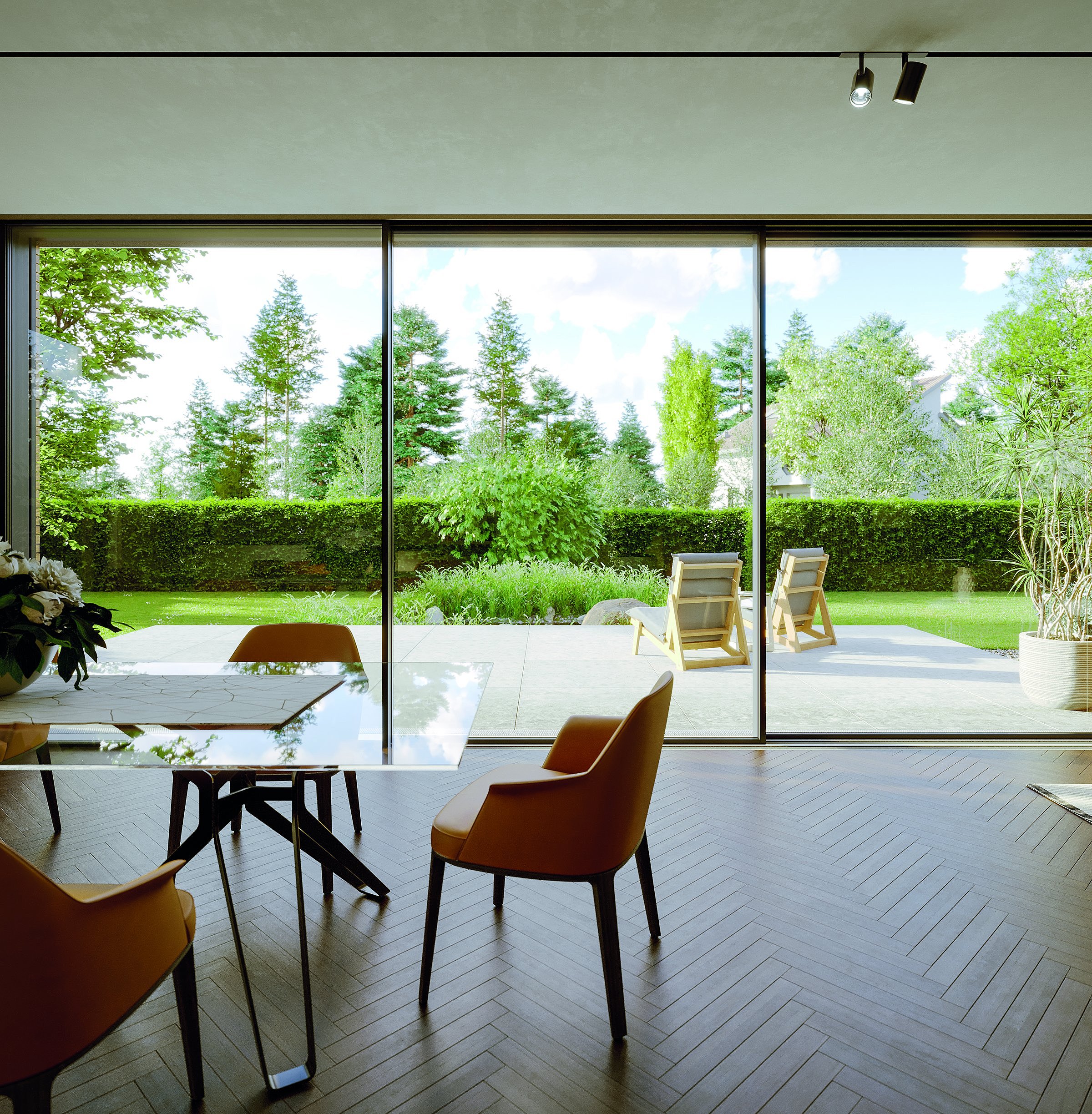
Many patio doors are narrow, have wide frames, intrusive thresholds, and take up a lot of space when open. This reduces the view and comfort. Sliding window systems allow for large-area sliding doors with up to 98% glass area and barrier-free thresholds compliant with DIN 18024. Slim profiles provide an almost frameless panoramic view, and U-values ​​starting at 0.75 W/m² K (depending on size and glazing) enhance energy efficiency. This creates a seamless transition between living space and garden.

Conservatory, summer garden and combination with patio roof

For conservatories and sunrooms, weather protection, transparency, and thermal insulation should all work together. In combination with SUNFLEX patio roofs, SF40, SF60, and SF80 are ideal for use as conservatory glazing. For sunroom glazing, SF40, as an uninsulated system, is the best and most economical solution.

Tested air, driving rain and wind load classes offer specialist companies the best basis for planning. 

Balcony sliding door and loggia glazing

Open loggias and balconies are exposed to wind and weather, while solid interior walls restrict light and flexibility. Sliding window systems allow for large-scale glazing of loggias and balconies. Two- or three-track versions with up to six panels enable particularly wide openings, and low-barrier thresholds enhance comfort. Depending on the location and usage requirements, SF40, SF60, or SF80 models are used.

Not suitable for

  • Load-bearing structures (the systems do not replace the main load-bearing structure)
  • Projects with the highest thermal insulation requirements (e.g., Passive House standard) when using uninsulated SF40
  • Very small openings under 1,000 mm wide or 500 mm high

Detailed structural analysis and building physics calculations (e.g., load-bearing capacity, moisture protection) are prepared on a project-specific basis by specialist planners or structural engineers.

What problems do SUNFLEX sliding window systems solve compared to standard sliding doors?

Standard sliding doors are often limited in size, airtightness, security, comfort, and insulation. SUNFLEX sliding window systems address these limitations:

  • View: extremely high glass proportions (up to 98%) and extra narrow profiles for panoramic views.
  • Opening widths: System widths up to 13,800 mm with multiple sliding panels.
  • Opening mechanism: Space-saving sliding function (no spanel area required)
  • Airtightness & insulation: Multiple sealing levels and the lowest U-values ​​starting at 0.75 W/m²K (SF60/SF80, depending on the glazing).
  • Security: Effective burglar protection up to RC2 and securely lockable mushroom-head locking bolts.
  • Comfort: Ball-bearing stainless steel rollers, integrated follower mechanism, barrier-free thresholds.
  • Durability: Aluminum and stainless steel track technology for long-lasting use.
  • Planning options: Individual configuration ensures you always find the ideal sliding window.

What distinguishes SUNFLEX sliding window systems from other SUNFLEX systems?

With SUNFLEX sliding window systems, the glass panels move linearly on 2- or 3-track rails. This ensures the panels always remain flush on one plane, without protruding into the room. In contrast, sliding-folding systems and folding-sliding systems open by rotating or folding the panels, allopanel entire fronts to be opened almost completely, but requiring more space to the inside or outside.

Configuring and planning sliding windows

Using the SUNFLEX configurator, you can create your project and explore individual variations. For detailed planning, technical design, and a specific quote, in the final step of the configuration process, you select a SUNFLEX specialist partner near you who will professionally handle measurements, consultation, and installation.
 

Frequently Asked Questions about SUNFLEX sliding window systems SF40 / SF60 / SF80

Which sliding window system is suitable for my building project – SF40, SF60 or SF80?

As a general guideline: SF40 (uninsulated) is the perfect solution for summer gardens and seasonally used areas. SF60 (thermally insulated) is ideal for patio access and conservatories adjoining heated rooms. If you are planning a year-round living space extension with particularly high energy efficiency requirements, SF80 (highly thermally insulated) is the best choice. Your SUNFLEX specialist partner will discuss your needs and energy requirements and then recommend the appropriate system.

What does burglary protection according to standard RC2 mean?

RC2 (Resistance Class 2, formerly WK2) is a European resistance class for burglar-resistant windows and doors according to DIN EN 1627. The standard specifies that the component must withstand an attempted break-in using simple leverage tools such as screwdrivers, pliers, or wedges for at least three minutes. SUNFLEX sliding windows with RC2 features are equipped with multi-point locking mushroom-head bolts, reinforced aluminum profiles, and impact-resistant glazing (P4A). This combination significantly hinders prying open the panels and effectively deters opportunistic burglars.

Statistics show that most burglars give up after three minutes of unsuccessful attempts. Insurance companies and the police recommend RC2 burglar protection for residential buildings in typical neighborhoods.

What is the difference between uninsulated (SF40), thermally insulated (SF60) and highly thermally insulated (SF80)?

SF40 is an uninsulated aluminum system with a shallower profile and thinner glass. It is ideal for unheated or seasonal areas. SF60 features thermally insulated profiles with a greater profile depth and thicker glass, resulting in significantly improved thermal insulation. SF80 is even more robust, accommodates high-performance glass, and thus offers the lowest U-values ​​currently available, starting at 0.75 W/m²K, as well as the highest test ratings for driving rain and wind loads. These three systems provide a clear progression in insulation level, ensuring you can find the perfect sliding window for your project.

What thermal insulation values ​​(Uw values) do the SF60 and SF80 systems achieve?

For the thermally insulated systems SF60 and SF80, Uw values ​​from 0.75 W/m²K are possible, depending on the glass construction, element size, and boundary conditions. These values ​​are calculated specifically for each project, as every glazing configuration and dimension yields different results. Your specialist partner can perform a precise Uw calculation based on the planning sketches and glass specifications. This allows the thermal insulation to be tailored to the building and its energy efficiency goals.

How accessible are the sliding window systems and do they comply with DIN 18024?

The lower frame structure can be installed flush with the floor, creating a virtually threshold-free solution. This allows the systems to meet the requirements of DIN 18024 for barrier-free construction, for example, for people with reduced mobility or strollers. The exact design of the threshold and drainage is tailored to each project by the specialist company. 

What are the maximum possible dimensions and panel weights?

The sliding window systems can reach widths of up to 13,800 mm and heights of up to 4,000 mm, with minimum dimensions of 1,000 mm width and 500 mm height. Depending on the model, 2 to 6 panels are possible. The SF40 allows for panel weights of up to 400 kg, while the SF60 and SF80 allow up to 800 kg per panel. This enables the design of very large glass facades. The maximum dimensions that are practical in each individual case depend on wind loads, glass construction, and fastening system, and are determined during the specialist planning phase.

How does the follower function work when opening and closing?

The integrated follower mechanism connects the sliding panels so that when the operating panel is moved, the other panels are automatically moved along with it. When closing, the subsequent panels are pulled into the final position one after the other, without the need to move each panel individually. This simplifies operation, especially with wide systems and heavy panels. At the same time, the defined movement sequence ensures a consistent seal.

Ball-bearing stainless steel rollers and stainless steel tracks guarantee smooth, virtually frictionless opening and closing of the panels, regardless of their weight.

What do 2-track and 3-track mean in the context of sliding windows?

The number of tracks describes how many parallel guide rails are present in the floor and ceiling profiles. In a two-track system, panels can run on two tracks, and in a three-track system, on three tracks. This allows for different opening configurations and greater opening widths, such as parking multiple panels sideways on one side. The appropriate number of tracks depends on the floor plan and the desired opening width.

Can the systems be combined to open to the left and right?

Yes, the systems can be designed so that the panels open to the left, to the right, or in both directions. This allows for central openings, asymmetrical layouts, and various operating concepts. The planning process takes into account the main traffic routes, furniture placement, and sight lines. Your specialist partner will develop a suitable opening plan based on these specifications.

How is the compensation of construction tolerances made possible during installation?

The systems are designed so that construction tolerances can be compensated for using mounting shoes and adjustment options. The frames are first roughly aligned, then fine-tuned using mounting shoes and adjusting screws. Even after glazing, the panels can still be readjusted in height and lateral position. This ensures that the smooth operation of the sliding panels is maintained even on uneven surfaces.

Can the systems also be used as room dividers indoors?

Yes, sliding window systems can be used as transparent room dividers, for example between the kitchen and dining area or between living and working zones. Depending on their position relative to the facade and climatic requirements, an uninsulated (SF40) or an insulated one can be used.

The system (SF60/SF80) would be beneficial. The advantage: rooms are visually connected, but remain acoustically and functionally separate. At the same time, the high proportion of glass is maintained, allopanel daylight to flow freely.

Which wind load and driving rain tightness classes have been tested?

For SF60, tests have shown very good air permeability (Class 4), high resistance to driving rain (Class 9A), and strong wind load class C3/B5 – far exceeding the standard of conventional sliding doors. For SF80, top performance has been demonstrated: air permeability (Class 4), resistance to driving rain up to the highest class E750, and wind load class C5, the highest achievable classes for windows and doors. These outstanding values ​​mean that the systems withstand even extreme weather conditions and are ideally suited for highly exposed locations such as sloping sites or coastal regions. The specific classification for a given project is determined based on the planning documents and the installation situation.

Where can I find a SUNFLEX specialist partner for advice and installation?

SUNFLEX collaborates with qualified specialist partners in Germany and worldwide who support you with planning, consultation, and professional installation. You can quickly find a certified partner near you using the specialist partner search on the SUNFLEX website. These partners are familiar with the technical requirements of the sliding window systems and can advise you on dimensions, insulation values, and available features.

Quality, audits & international experience

SUNFLEX has been developing and producing sliding, folding, and glazing systems for decades and has an international presence with partners and locations. The SF40, SF60, and SF80 sliding window systems are CE-marked and have been tested by independent testing institutes for air permeability, resistance to driving rain, wind load, and burglar resistance, among other things. Global project experience guarantees reliable systems and a high degree of planning security for private homeowners and specialist companies.

Your made-to-measure summer garden

Make your dream of your own summer garden come true: Simply combine your folding door system with a terrace roof from SUNFLEX and get more out of life in every season. Our high-quality terrace roofs can be customised to your personal living situation and individual snow load.

SUNFLEX terrace doors

The right glass system for your terrace door
Find out more

SUNFLEX loggia glazing

The optimum solution for your loggia glazing
Find out more

SUNFLEX room divider

Room divider made of glass for maximum light flooding
Find out more

SUNFLEX terrace roof

Long-lasting terrace roofs for every requirement
Find out more

Brochure

Look for a SUNFLEX trade partner

Find now

Sliding systems

Find out more

Sliding door systems

Find out more

Slide and Turn Systems

Find out more

Folding Door Systems

Find out more

Terrace Roofs

Find out more